


Tẹ́lískópù Òfurufú Hubble
 The Hubble Space Telescope as seen from the departing Ọkọ̀-àlọbọ̀ Òfurufú Atlantis, flying Servicing Mission 4 (STS-125), the fifth and final human spaceflight to visit the observatory. | |
| Ìrojọ́ gbogbogbo | |
|---|---|
| NSSDC ID | 1990-037B |
| Àgbàjọ | NASA / ESA / STScI |
| Ọjọ́ ìgbéra | April 24, 1990, 8:33:51 am EDT[1][2] |
| Ọkọ̀ tófi gbéra | Ọkọ̀-àlọbọ̀ Òfurufú Discovery (STS-31) |
| Ìgbà ìránlọṣe | ọdún 34 àti ọjọ́ 1 ló ti kọjá |
| Kúrò lọ́nà-àyípo | due ~2013–2021[3][4] |
| Àkọ́jọ | 11,110 kg (24,490 lb) |
| Irú ọ̀nà-àyípo | Near-circular low Earth orbit |
| Ìga ọ̀nà-àyípo | 559 km (347 mi) |
| Àkókò ọ̀nà-àyípo | 96–97 minutes (14-15 periods per day) |
| Ìmúyára ọ̀nà-àyípo | 7,500 m/s (25,000 ft/s) |
| Ìmúsáré nítorí agbárá ìfàmọ́ra | 8.169 m/s2 (26.80 ft/s2) |
| Ibùgbé | Low Earth orbit |
| Telescope style | Ritchey–Chrétien reflector |
| Ìbú ìrúkèrúlẹ̀ | visible light, ultraviolet, near-infrared |
| Ìdákọjá | 2.4 m (7 ft 10 in) |
| Collecting area | 4.5 m2 (48 sq ft)[5] |
| Ìbú ìtẹjúmọ́ | 57.6 m (189 ft) |
| Àwọn irinṣẹ́ | |
| NICMOS | infrared camera/spectrometer |
| ACS | optical survey camera (partially failed) |
| WFC3 | wide field optical camera |
| COS | ultraviolet spectrograph |
| STIS | optical spectrometer/camera |
| FGS | three fine guidance sensors |
| Ibiìtakùn | hubble.nasa.gov/ hubblesite.org/ spacetelescope.org |
Tẹ́lískópù Òfurufú Hubble tabi Agbéwọ̀ọ́kán Òfurufú Hubble (Hubble Space Telescope; HST tabi TOH) je teliskopu ofurufu kan to je gbigbe lo sinu onaayipo pelu Oko Alobo kan ni 1990, to si wa nibe latigba na. O je teliskopu to ni enu-iwole imole 2.4-meter (7.9 ft), o si wa ni onaayipo isale Aye, awon irinse mererin pataki Hubble le sakiyesi ni itanka eti inuaro, alafojuri, ati eti inupupa. Teliskopu na je sisoloruko fun atorawo Edwin Hubble.
Ona-ayipo Hubble to wa niwaju ibi idilona ojuayika Aye gba laaye lati ya awon aworan to han kedere lai si ina eyin. Aworan Papa Ijin De le Hubble, fun apere lo je aworan afojuri ina to kunrere julo fun ohun to jinna to je yiya ni foto ni agbala aye. Opo awon akiyesi Hubble ti fa ojutu isoro ninu sayensi fisiksionirawo, bi sise bi agbala aye se unfe si gerege.
Bo tilejepe ki se teliskopu ofurufu akoko, Hubble je ikan ninu awon to tobijulo ati to se e mulo fun orisirisi ise, ati ohun iwadi to se pataki ati ohun ibasepo igboro fun itorawo. TOH je kiko latowo ile-ise eto ofurufu Amerika NASA, pelu ifikun latodo Ile-ise Ofurufu Europe, o si unje mimusise latowo Space Telescope Science Institute. Teliskopu na je ikan ninu awon Ibi Isakiyesi Gbangba ti NASA, lapapo mo Compton Gamma Ray Observatory, Chandra X-ray Observatory, ati Teliskopu Ofurufu Spitzer.[6]
Awon teliskopu ofurufu je dida laba lati odun 1923. Owo fun iko Hubble bere sini je kikojo ni ewadun 1970s, pelu ireti pe yio gbera ni 1983, sugbon o ku seyin nitori isoro isise, inawo ati ijamba Challenger. Nigba to gbeyin gbera ni 1990, awon onimo sayensi ri pe jigi iwaju re ko duro daada, eyi fa ko mo sise boseye. Iranlose se atunse eyi ni 1993.
Hubble ni teliskopu kan soso to je sise lati se atunse re ninu ofurufu latowo awon arinlofurufu. Larin 1993 ati 2002, iranlose merin se atunse, isodotun ati won se idipo awon sistemu ninu teliskopu na; iranlose karun je fifagile fun abo leyin ijamba Columbia. Sugbon leyin iforowero igboro to waye, oludari NASA Mike Griffin fase si iranlose atunse to gbeyin, eyi waye ni 2009. Ireti ni pe teliskopu na yio sise titi di 2014 o kereju. Eyi ti yio ropo re ni Teliskopu Ofurufu James Webb (JWST), eyi yio gbera ni 2018 tabi leyin igba yi.
Idaro, ida ati awon afojusun[àtúnṣe | àtúnṣe àmìọ̀rọ̀]
Ìdámọ̀ràn àtí àwọn asíwájú[àtúnṣe | àtúnṣe àmìọ̀rọ̀]
Ni 1923, Hermann Oberth — to je gbigba bi baba ise roketi ayeodeoni, lapapo mo Robert H. Goddard ati Konstantin Tsiolkovsky — setewejade Die Rakete zu den Planetenräumen ("Roketi sinu Ofurufu Planeti"; "The Rocket into Planetary Space"), to fenu ba bawo ni teliskopu se le je mu jijulo sinu ona-ayika Aye pelu roketi.[7]
Itan Teliskopu Ofurufu Hubble se wa seyin de odun 1946, nigbati atorawo Lyman Spitzer ko iwe-ayoka kan to unje "Astronomical advantages of an extraterrestrial observatory" (Awon anfani itorawo ibi-isakiyesi ojuorun).[8] Ninu re, o jiroro nipa awon anfan pataki meji ti ibi-isakiyesi to budo si ofurufu ni lori awon teliskopu to budo si ori ile. Akoko, igbehan onigun (ijinna kekerejulo nibi ti awon ohunkan se le e damo) yio je sisaropin lasan latowo igedakoja, kaka ko je latowo iji ni oju-ayika, to unje ki awon irawo o tan yinrinyinrin, to je mimo bi iwo latowo awon atorawo. Lasiko na awon teliskopu ibudo ori ile igbana ni igbehan ti ko din ju 0.5–1.0 arcseconds lo, ti a ba fiwe mo igbehan 0.05 arcsec ti igedakoja saropin yio ni fun teliskopu pelu jigi ti idakoja re je 2.5 m. Ekeji, teliskopu ibudo ofurufu le sakiyesi imole oninupupa ati oninuaro, ti won le sonu soju-ayika fun teliskopu ibudo ori ile.
Spitzer lo gbogbo asiko ise re si pipe fun igbedide teliskopu ofurufu. Ni 1962, ijabo iwadi Akademi awon Sayensi Orile-ede Amerika da aba igbedide teliskopu ofurufu gege bi apa eto ofurufu, ati ni 1965 Spitzer je yiyansipo bi olori igbimo ti ise re je lati setoka ona sayensi fun teliskopu ofurufu ninla.[9]
Itorawo ibudo ofurufu ti bere diedie leyin Ogun Agbaye 2k, bi awon onimo sayensi se lo awon igbedide to ti waye ninu oroiseona rọ́kẹ̀tì. Ìgbàjá-àwọ̀ onínúaró àkọ́kọ́ ti Òrùn jẹ́ rírí ní 1946,[10] NASA sì ṣègbéra Orbiting Solar Observatory (OSO) láti gba àwọn ìgbàjá UV, ìtànká-X (X-ray), àti ìtànká gamma ní 1962.[11] Tẹ́lískópù ọ̀nà-àyípo òrùn kan jẹ́ gbígbérá ní 1962 látọwọ́ Ilẹ̀ọba Aṣọ̀kan bíi apá ètò òfurufú Ariel, bẹ́ẹ̀sìni ní 1966 NASA ṣègbéra ìránlọṣe Orbiting Astronomical Observatory (OAO) àkọ́kọ́. Bátìrì OAO-1 kùnà lẹ̀yìn ọjọ́ mẹ́ta, èyí fi òpin sí ìránlọṣe náà. OAO-2 tó rọ́pò rẹ̀ ṣe àkíyèsí onínúaró àwọn ìràwọ̀ àti gáláksì láti ìgbà ìgbéra rẹ̀ ní 1968 títí di 1972, èyí pẹ́ ju ọdún kan tí wọ́n gbèrò fun lọ.[12]
Àwọn ìránlọṣe OSO àti OAO fihàn bí àwọn àkíyèsí ibùdó òfurufú ṣe ṣe pàtàkì sí nínú ìtòràwọ̀, bó sì ṣe di 1968, NASA ṣàgbédìde àwọn ètò gidi fún tẹ́lískópù alátànpadà pẹ̀lú jígí tí ìdákọjá rẹ̀ jẹ́ 3 m, tó jẹ́ mímọ̀ nígbà náà bíi Large Orbiting Telescope tàbí Large Space Telescope (LST), tí yíò gbéra ní 1979. Awon eto yi tenumo bi o se se pataki fun awon iranlose itoju pelu awon eniyan lo si teliskopu na lati ri pe iru eto alewo na ni emi ojo pipe, besini igbedide lasiko kanna eto fun and the concurrent development of plans for the reusable oko alobo alatunmulo fihan pe oroiseona ti yio gba eyi laye ko ni pe waye.[13]
Ìpèsè owó fún kíkọ́ rẹ̀[àtúnṣe | àtúnṣe àmìọ̀rọ̀]
Ni 1974, Kongresi jawo inawo fun eto teliskopu na.[14] Nitorie opo awon atorawo bere ipade pelu awon asoju ati alagba asofin lati ri pe owo ko ja lori igbedidide re. Nigbeyin Kongresi pinu lati da inawo re si abo.[15]
Nitori aito owo lo fa ti European Space Agency se pinu lati pese owo ati irinse fun teliskopu na, ati batiri olorun ti yio fun ni agbara, ati awon osise lati sise lori teliskopu na ni Amerika, fun eyi won yio fun awon atorawo ara Europe ni 15% asiko isakiyesi lori teliskopu na.[16] Nigbeyin Kongresi fi ase si ipese owo to to US$36,000,000 fun 1978, be sini iyaeto LST bere, pelu ero lati gbera ni 1983.[15] Ni 1983 teliskopu na je sisoloruko[17] fun Edwin Hubble, eni to sewari ikan ninu awon awari sayensi orundun 20k nigbato sawari pe agbala aye unfesi.[18]
Ìkọ́ àti iṣẹ́ẹ̀rọ[àtúnṣe | àtúnṣe àmìọ̀rọ̀]

Leyin ti iseowo Teliskopu Ofurufu na ti gba ase, ise bere kiakia lori re, o si je pinpin larin opo awon ile-ise. Marshall Space Flight Center (MSFC) lo gba ase lati daeto, sagbedide ati ko teliskopu na, nigbati Goddard Space Flight Center gba ase isejanu apapo awon irinse sayensi ati gbongan ibi ikojanu ori ile fun iranlose na.[19] MSFC gbe ise fun ile-ise isiseiriran Perkin-Elmer lati daeto ati ko Optical Telescope Assembly (OTA) ati Fine Guidance Sensors fun teliskopu na. Lockheed gba ise lati ko ati searomo oko-ofurufu ti teliskopu na yio duro si.[20]
Optical Telescope Assembly (OTA)[àtúnṣe | àtúnṣe àmìọ̀rọ̀]
Fun iworan, TOH unlo Cassegrain reflector ti afowoda Ritchey-Chrétien, bo se je fun opo awon teliskopu isise miran. Afowoda yi, pelu jigi atenikun meji (hyperbolic mirrors), gbajumo fun iseaworan todara lori ibi iriran to fe gidi, pelu ainianfani pe awon bi awon jigi na se ri soro lati da ati danwo. Jigi ati sistemu onitiworan ti teliskopu na ni ni won unso bi yio se sise daradara si, be sini won je fifowoda ni iye pato. Awon teliskopu onitiworan saba ni jigi to ti je didan to ni isegeege bi ti idamewa ibuiruila itanmole afojuri, sugbon Teliskopu Ofurufu yi unje lilo fun isakiyesi lati itanmole afojuri de oninuawoaro (ibu-iruila kere) be sini o gbodo ni diffraction limited pato lati le lo gbogbo anfani ti ayiko ofurufu pese. Nitori eyi, jigi re gbodo je didan de isegeere 10 nanometers, bi tabi 1/65 ibu-iruila itanmole awopupa.[21] Ni apa ibu-iruila togun, OTA na je fifowoda pelu pe IR re yio sise boseye daada — fun apere, awon jigi ni igbonasi toduro laimi (won si loworo, bi 15 °C). Eyi fa ala si ise Hubble bi teliskopu oninuawopupa.[22]
Perkin-Elmer intended to use custom-built and extremely sophisticated computer-controlled polishing machines to grind the mirror to the required shape.[20] However, in case their cutting-edge technology ran into difficulties, NASA demanded that PE sub-contract to Kodak to construct a back-up mirror using traditional mirror-polishing techniques.[23] (The team of Kodak and Itek also bid on the original mirror polishing work. Their bid called for the two companies to double-check each other's work, which would have almost certainly caught the polishing error that later caused such problems.[24]) The Kodak mirror is now on permanent display at the Smithsonian Institution.[25][26] An Itek mirror built as part of the effort is now used in the 2.4 m telescope at the Magdalena Ridge Observatory.[27]
Construction of the Perkin-Elmer mirror began in 1979, starting with a blank manufactured by Corning from their ultra-low expansion glass. To keep the mirror's weight to a minimum it consisted of inch-thick top and bottom plates sandwiching a honeycomb lattice. Perkin-Elmer simulated microgravity by supporting the mirror on both sides with 138 rods that exerted varying amounts of force. This ensured that the mirror's final shape would be correct and to specification when finally deployed. Mirror polishing continued until May 1981. NASA reports at the time questioned Perkin-Elmer's managerial structure, and the polishing began to slip behind schedule and over budget. To save money, NASA halted work on the back-up mirror and put the launch date of the telescope back to October 1984.[28] The mirror was completed by the end of 1981; it was washed using 2,400 gallons (9,100 L) of hot, deionized water and then received a reflective coating of aluminum 65 nm-thick and a protective coating of magnesium fluoride 25 nm-thick.[22][29]

Doubts continued to be expressed about Perkin-Elmer's competence on a project of this importance, as their budget and timescale for producing the rest of the OTA continued to inflate. In response to a schedule described as "unsettled and changing daily", NASA postponed the launch date of the telescope until April 1985. Perkin-Elmer's schedules continued to slip at a rate of about one month per quarter, and at times delays reached one day for each day of work. NASA was forced to postpone the launch date until March and then September 1986. By this time, the total project budget had risen to US$1.175 billion.[30]
Spacecraft systems[àtúnṣe | àtúnṣe àmìọ̀rọ̀]
The spacecraft in which the telescope and instruments were to be housed was another major engineering challenge. It would have to withstand frequent passages from direct sunlight into the darkness of Earth's shadow, which would cause major changes in temperature, while being stable enough to allow extremely accurate pointing of the telescope. A shroud of multi-layer insulation keeps the temperature within the telescope stable, and surrounds a light aluminum shell in which the telescope and instruments sit. Within the shell, a graphite-epoxy frame keeps the working parts of the telescope firmly aligned.[31] Because graphite composites are hygroscopic, there was a risk that water vapor absorbed by the truss while in Lockheed's clean room would later be expressed in the vacuum of space; the telescope's instruments would be covered in ice. To reduce that risk, a nitrogen gas purge was performed before launching the telescope into space.[32]

While construction of the spacecraft in which the telescope and instruments would be housed proceeded somewhat more smoothly than the construction of the OTA, Lockheed still experienced some budget and schedule slippage, and by the summer of 1985, construction of the spacecraft was 30% over budget and three months behind schedule. An MSFC report said that Lockheed tended to rely on NASA directions rather than take their own initiative in the construction.[33]
Initial instruments[àtúnṣe | àtúnṣe àmìọ̀rọ̀]
When launched, the HST carried five scientific instruments: the Wide Field and Planetary Camera (WF/PC), Goddard High Resolution Spectrograph (GHRS), High Speed Photometer (HSP), Faint Object Camera (FOC) and the Faint Object Spectrograph (FOS). WF/PC was a high-resolution imaging device primarily intended for optical observations. It was built by NASA's Jet Propulsion Laboratory, and incorporated a set of 48 filters isolating spectral lines of particular astrophysical interest. The instrument contained eight charge-coupled device (CCD) chips divided between two cameras, each using four CCDs. Each CCD has a resolution of 0.64 megapixels.[34] The "wide field camera" (WFC) covered a large angular field at the expense of resolution, while the "planetary camera" (PC) took images at a longer effective focal length than the WF chips, giving it a greater magnification.[35]
The GHRS was a spectrograph designed to operate in the ultraviolet. It was built by the Goddard Space Flight Center and could achieve a spectral resolution of 90,000.[36] Also optimized for ultraviolet observations were the FOC and FOS, which were capable of the highest spatial resolution of any instruments on Hubble. Rather than CCDs these three instruments used photon-counting digicons as their detectors. The FOC was constructed by ESA, while the University of California, San Diego and the Martin Marietta corporation built the FOS.[35]
The final instrument was the HSP, designed and built at the University of Wisconsin–Madison. It was optimized for visible and ultraviolet light observations of variable stars and other astronomical objects varying in brightness. It could take up to 100,000 measurements per second with a photometric accuracy of about 2% or better.[37]
HST's guidance system can also be used as a scientific instrument. Its three Fine Guidance Sensors (FGS) are primarily used to keep the telescope accurately pointed during an observation, but can also be used to carry out extremely accurate astrometry; measurements accurate to within 0.0003 arcseconds have been achieved.[38]
Ground support[àtúnṣe | àtúnṣe àmìọ̀rọ̀]

The Space Telescope Science Institute (STScI) is responsible for the scientific operation of the telescope and delivery of data products to astronomers. STScI is operated by the Association of Universities for Research in Astronomy (AURA) and is physically located in Baltimore, Maryland on the Homewood campus of Johns Hopkins University, one of the 33 US universities and seven international affiliates that make up the AURA consortium. STScI was established in 1981 [39] after something of a power struggle between NASA and the scientific community at large. NASA had wanted to keep this function "in-house", but scientists wanted it to be based in an academic establishment.[40][41] The Space Telescope European Coordinating Facility (ST-ECF), established at Garching bei München near Munich in 1984, provides similar support for European astronomers.
One rather complex task that falls to STScI is scheduling observations for the telescope.[42] Hubble is in a low-Earth orbit so that it can be reached by the space shuttle for servicing missions, but this means that most astronomical targets are occulted by the Earth for slightly less than half of each orbit. Observations cannot take place when the telescope passes through the South Atlantic Anomaly due to elevated radiation levels, and there are also sizable exclusion zones around the Sun (precluding observations of Mercury), Moon and Earth. The solar avoidance angle is about 50°, which is specified to keep sunlight from illuminating any part of the OTA. Earth and Moon avoidance is to keep bright light out of the FGSs and to keep scattered light from entering the instruments. If the FGSs are turned off, however, the Moon and Earth can be observed. Earth observations were used very early in the program to generate flat-fields for the WFPC1 instrument. There is a so-called continuous viewing zone (CVZ), at roughly 90 degrees to the plane of Hubble's orbit, in which targets are not occulted for long periods. Due to the precession of the orbit, the location of the CVZ moves slowly over a period of eight weeks. Because the limb of the Earth is always within about 30° of regions within the CVZ, the brightness of scattered earthshine may be elevated for long periods during CVZ observations.
Because Hubble orbits in the upper atmosphere, its orbit changes over time in a way that is not accurately predictable. The density of the upper atmosphere varies according to many factors, and this means that Hubble's predicted position for six weeks' time could be in error by up to 4,000 km. Observation schedules are typically finalized only a few days in advance, as a longer lead time would mean there was a chance that the target would be unobservable by the time it was due to be observed.[43]
Engineering support for HST is provided by NASA and contractor personnel at the Goddard Space Flight Center in Greenbelt, Maryland, 48 km south of the STScI. Hubble's operation is monitored 24 hours per day by four teams of flight controllers who make up Hubble's Flight Operations Team.[44]
Challenger disaster, delays, and eventual launch[àtúnṣe | àtúnṣe àmìọ̀rọ̀]
By early 1986, the planned launch date of October that year looked feasible, but the Challenger accident brought the U.S. space program to a halt, grounding the space shuttle fleet and forcing the launch of Hubble to be postponed for several years. The telescope had to be kept in a clean room, powered up and purged with nitrogen, until a launch could be rescheduled. This costly situation (about $6 million per month) pushed the overall costs of the project even higher. This delay did allow time for engineers to perform extensive tests, swap out a possibly failure-prone battery, and make other improvements.[45] Furthermore, the ground software needed to control Hubble was not ready in 1986, and in fact was barely ready by the 1990 launch.[46]

Eventually, following the resumption of shuttle flights in 1988, the launch of the telescope was scheduled for 1990. On April 24, 1990, shuttle mission STS-31 saw Discovery launch the telescope successfully into its planned orbit.[47]
From its original total cost estimate of about US$400 million, the telescope had by now cost over $2.5 billion to construct. Hubble's cumulative costs up to this day are estimated to be several times higher still, with US expenditure estimated at between $4.5 and $6 billion, and Europe's financial contribution at €593 million (1999 estimate).[48]
Flawed mirror[àtúnṣe | àtúnṣe àmìọ̀rọ̀]
Within weeks of the launch of the telescope, the returned images indicated a serious problem with the optical system. Although the first images appeared to be sharper than those of ground-based telescopes, Hubble failed to achieve a final sharp focus and the best image quality obtained was drastically lower than expected. Images of point sources spread out over a radius of more than one arcsecond, instead of having a point spread function (PSF) concentrated within a circle 0.1 arcsec in diameter as had been specified in the design criteria.[49][50]

Analysis of the flawed images showed that the cause of the problem was that the primary mirror had been ground to the wrong shape. Although it was probably the most precisely figured mirror ever made, with variations from the prescribed curve of only 10 nanometers,[21] at the perimeter it was too flat by about 2,200 nanometers (2.2 micrometres).[51] This difference was catastrophic, introducing severe spherical aberration, a flaw in which light reflecting off the edge of a mirror focuses on a different point from the light reflecting off its center.[52]
The effect of the mirror flaw on scientific observations depended on the particular observation—the core of the aberrated PSF was sharp enough to permit high-resolution observations of bright objects, and spectroscopy was largely unaffected. However, the loss of light to the large, out of focus halo severely reduced the usefulness of the telescope for faint objects or high-contrast imaging. This meant that nearly all of the cosmological programs were essentially impossible, since they required observation of exceptionally faint objects.[52] NASA and the telescope became the butt of many jokes, and the project was popularly regarded as a white elephant. (For instance, in the 1991 comedy The Naked Gun 2½: The Smell of Fear, the Hubble was pictured with theTitanic, the Hindenburg, and the Edsel).[53] Nonetheless, during the first three years of the Hubble mission, before the optical corrections, the telescope still carried out a large number of productive observations. The error was well characterized and stable, enabling astronomers to optimize the results obtained using sophisticated image processing techniques such as deconvolution.[54]
Origin of the problem[àtúnṣe | àtúnṣe àmìọ̀rọ̀]

A commission headed by Lew Allen, director of the Jet Propulsion Laboratory, was established to determine how the error could have arisen. The Allen Commission found that the main null corrector, a testing device used to achieve a properly shaped non-spherical mirror, had been incorrectly assembled—one lens was wrongly spaced by 1.3 mm.[55] During the initial grinding and polishing of the mirror, Perkin-Elmer analyzed its surface with two conventional null correctors. However, for the final manufacturing step (figuring), they switched to a custom-built null corrector, designed explicitly to meet very strict tolerances. Ironically, this device was mis-assembled, resulting in an extremely precise (but wrong) shape for the mirror. There was one final opportunity to catch the error, since a few of the final tests needed to use conventional null correctors for various technical reasons. These tests correctly indicated spherical aberration. However, the company ignored these results, as it believed they were less accurate than the primary device which reported that the mirror was perfectly figured.[56]
The commission blamed the failings primarily on Perkin-Elmer. Relations between NASA and the optics company had been severely strained during the telescope construction, due to frequent schedule slippage and cost overruns. NASA found that Perkin-Elmer did not review or supervise the mirror construction adequately, did not assign its best optical scientists to the project (as it had for the prototype), and in particular did not involve the optical designers in the construction and verification of the mirror. While the commission heavily criticized Perkin-Elmer for these managerial failings, NASA was also criticized for not picking up on the quality control shortcomings, such as relying totally on test results from a single instrument.[57]
Design of a solution[àtúnṣe | àtúnṣe àmìọ̀rọ̀]

The design of the telescope had always incorporated servicing missions, and astronomers immediately began to seek potential solutions to the problem that could be applied at the first servicing mission, scheduled for 1993. While Kodak and Itek had each ground back-up mirrors for Hubble, it would have been impossible to replace the mirror in orbit, and too expensive and time-consuming to bring the telescope back to Earth for a refit. Instead, the fact that the mirror had been ground so precisely to the wrong shape led to the design of new optical components with exactly the same error but in the opposite sense, to be added to the telescope at the servicing mission, effectively acting as "spectacles" to correct the spherical aberration.[58][59]
The first step was a precise characterization of the error in the main mirror. Working backwards from images of point sources, astronomers determined that the conic constant of the mirror as built was −1.01390±0.0002, instead of the intended −1.00230.[60][61] The same number was also derived by analyzing the null corrector used by Perkin-Elmer to figure the mirror, as well as by analyzing interferograms obtained during ground testing of the mirror.[62]

Because of the way the HST's instruments were designed, two different sets of correctors were required. The design of the Wide Field and Planetary Camera 2, already planned to replace the existing WF/PC, included relay mirrors to direct light onto the eight separate CCD chips making up its two cameras. An inverse error built into their surfaces could completely cancel the aberration of the primary. However, the other instruments lacked any intermediate surfaces that could be figured in this way, and so required an external correction device.[63]
The Corrective Optics Space Telescope Axial Replacement (COSTAR) system was designed to correct the spherical aberration for light focused at the FOC, FOS, and GHRS. It consists of two mirrors in the light path with one ground to correct the aberration.[64] To fit the COSTAR system onto the telescope, one of the other instruments had to be removed, and astronomers selected the High Speed Photometer to be sacrificed.[63] By 2002, all of the original instruments requiring COSTAR had been replaced by instruments with their own corrective optics.[65] COSTAR was removed and returned to Earth in 2009 where it is exhibited at the National Air and Space Museum. The area previously used by COSTAR is now occupied by the Cosmic Origins Spectrograph.
Àwọn ìránlọṣe ìṣàtúnṣe àti àwọn irinṣẹ́ tuntun[àtúnṣe | àtúnṣe àmìọ̀rọ̀]

Hubble was designed to accommodate regular servicing and equipment upgrades. Five servicing missions (SM 1, 2, 3A, 3B, and 4) were flown by NASA space shuttles, the first in December 1993 and the last in May 2009. Servicing missions were delicate operations that began with maneuvering to intercept the telescope in orbit and carefully retrieving it with the shuttle's mechanical arm. The necessary work was then carried out in multiple tethered spacewalks over a period of four to five days. After a visual inspection of the telescope, astronauts conducted repairs, replaced failed or degraded components, upgraded equipment, and installed new instruments. Once work was completed, the telescope was redeployed, typically after boosting to a higher orbit to address any orbital decay caused by atmospheric drag.
Ìránlọṣe Ìṣàtúnṣe 1[àtúnṣe | àtúnṣe àmìọ̀rọ̀]

After the problems with Hubble's mirror came to light, the first servicing mission assumed a much greater importance, as the astronauts would have to carry out extensive work on the telescope to install the corrective optics. The seven astronauts selected for the mission were trained intensively in the use of the hundred or more specialized tools that would be needed.[66] SM1 flew aboard Endeavour in December 1993, and involved installation of several instruments and other equipment over 10 days.
Most importantly, the High Speed Photometer was replaced with the COSTAR corrective optics package, and WFPC was replaced with the Wide Field and Planetary Camera 2 (WFPC2) with its internal optical correction system. In addition, the solar arrays and their drive electronics were replaced, as well as four of the gyroscopes used in the telescope pointing system, two electrical control units and other electrical components, and two magnetometers. The onboard computers were upgraded, and the telescope's orbit was boosted.[51]
On January 13, 1994, NASA declared the mission a complete success and showed the first of many much sharper images.[67] At the time, the mission was one of the most complex ever undertaken, involving five lengthy periods of extra-vehicular activity, and its resounding success was an enormous boon for NASA, as well as for the astronomers who now had a fully capable space telescope.
Ìránlọṣe Ìṣàtúnṣe 2[àtúnṣe | àtúnṣe àmìọ̀rọ̀]

Servicing Mission 2, flown by Discovery in February 1997, replaced the GHRS and the FOS with the Space Telescope Imaging Spectrograph (STIS) and the Near Infrared Camera and Multi-Object Spectrometer (NICMOS), replaced an Engineering and Science Tape Recorder with a new Solid State Recorder, and repaired thermal insulation.[68] NICMOS contained a heat sink of solid nitrogen to reduce the thermal noise from the instrument, but shortly after it was installed, an unexpected thermal expansion resulted in part of the heat sink coming into contact with an optical baffle. This led to an increased warming rate for the instrument and reduced its original expected lifetime of 4.5 years to about 2 years.[69]
Ìránlọṣe Ìṣàtúnṣe 3A[àtúnṣe | àtúnṣe àmìọ̀rọ̀]
Servicing Mission 3A, flown by Discovery, took place in December 1999, and was a split-off from Servicing Mission 3 after three of the six onboard gyroscopes had failed. A fourth failed a few weeks before the mission, rendering the telescope incapable of performing scientific observations. The mission replaced all six gyroscopes, replaced a Fine Guidance Sensor and the computer, installed a Voltage/temperature Improvement Kit (VIK) to prevent battery overcharging, and replaced thermal insulation blankets.[70] The new computer is 20 times faster, with six times more memory, than the DF-224 it replaced. It increases throughput by moving some computing tasks from the ground to the spacecraft, and saves money by allowing the use of modern programming languages.[71]
Ìránlọṣe Ìṣàtúnṣe 3B[àtúnṣe | àtúnṣe àmìọ̀rọ̀]
Servicing Mission 3B flown by Columbia in March 2002 saw the installation of a new instrument, with the FOC (the last original instrument) being replaced by theAdvanced Camera for Surveys (ACS). This meant that COSTAR was no longer required, since all new instruments had built-in correction for the main mirror aberration.[65] The mission also revived NICMOS[69] and replaced the solar arrays for the second time, providing 30 percent more power.[72]
Ìránlọṣe Ìṣàtúnṣe 4[àtúnṣe | àtúnṣe àmìọ̀rọ̀]


|

| |
Hubble during SM4 and after release
| ||
Plans called for Hubble to be serviced in February 2005, but the Columbia disaster in 2003, in which Columbia disintegrated on re-entry into the atmosphere, had wide-ranging effects on the Hubble program. NASA Administrator Sean O'Keefe decided that all future shuttle missions had to be able to reach the safe haven of the International Space Station should in-flight problems develop. As no shuttles were capable of reaching both HST and the ISS during the same mission, future manned service missions were canceled.[73] This decision was assailed by numerous astronomers, who felt that Hubble was valuable enough to merit the human risk. HST's planned successor, the James Webb Telescope, is not expected to launch until at least 2018. A gap in space-observing capabilities between a decommissioning of Hubble and the commissioning of a successor is of major concern to many astronomers, given the significant scientific impact of HST.[74] The consideration that JWST will not be located in low Earth orbit, and therefore cannot be easily upgraded or repaired in the event of an early failure, only makes these concerns more acute. On the other hand, many astronomers felt strongly that the servicing of Hubble should not take place if the expense were to come from the JWST budget.

In January 2004, O'Keefe said he would review his decision to cancel the final servicing mission to HST due to public outcry and requests from Congress for NASA to look for a way to save it. The National Academy of Sciences convened an official panel, which recommended in July 2004 that the HST should be preserved despite the apparent risks. Their report urged "NASA should take no actions that would preclude a space shuttle servicing mission to the Hubble Space Telescope".[75] In August 2004, O'Keefe asked Goddard Space Flight Center to prepare a detailed proposal for a robotic service mission. These plans were later canceled, the robotic mission being described as "not feasible".[76] In late 2004, several Congressional members, led by Senator Barbara Mikulski, held public hearings and carried on a fight with much public support (including thousands of letters from school children across the country) to get the Bush Administration and NASA to reconsider the decision to drop plans for a Hubble rescue mission.[77]
The nomination in April 2005 of a new NASA Administrator, Michael D. Griffin, changed the situation, as Griffin stated he would consider a manned servicing mission.[78] Soon after his appointment Griffin authorized Goddard to proceed with preparations for a manned Hubble maintenance flight, saying he would make the final decision after the next two shuttle missions. In October 2006 Griffin gave the final go-ahead, and the 11-day mission by Atlantis was scheduled for October 2008. Hubble's main data-handling unit failed in September 2008,[79] halting all reporting of scientific data until its back-up was brought online on October 25, 2008.[80] Since a failure of the backup unit would leave the HST helpless, the service mission was postponed to incorporate a replacement for the primary unit.[79] Servicing Mission 4, flown by Atlantis in May 2009, was the last scheduled shuttle mission for HST.[81][82] SM4 installed the replacement data-handling unit, repaired the ACS and STIS systems, installed improved nickel hydrogen batteries, and replaced other components. SM4 also installed two new observation instruments—Wide Field Camera 3 (WTF3) and the Cosmic Origins Spectrograph(COS)[83]—and the Soft Capture and Rendezvous System, which will enable the future rendezvous, capture, and safe disposal of Hubble by either a crewed or robotic mission.[84] The work accomplished during SM4 is expected to render the telescope fully functioning at least into the year 2014, and perhaps longer.[81]
Àwọn àwábọ̀ fún sáyẹ́nsì[àtúnṣe | àtúnṣe àmìọ̀rọ̀]
Iṣẹ́ọwọ́ oníkókó[àtúnṣe | àtúnṣe àmìọ̀rọ̀]
In the early 1980s, NASA and STScI convened four panels to discuss Key Projects. These were projects that were both scientifically important and would require significant telescope time, which would be explicitly dedicated to each project. This guaranteed that these particular projects would be completed early, in case the telescope failed sooner than expected. The panels identified three such projects: (1) a study of the nearby intergalactic medium using quasar absorption lines to determine the properties of the intergalactic medium and the gaseous content of galaxies and groups of galaxies;[85] (2) a medium deep survey using the Wide Field Camera to take data whenever one of the other instruments was being used[86] and (3) a project to determine the Hubble Constant within ten percent by reducing the errors, both external and internal, in the calibration of the distance scale.[87]
Àwọn àwárí pàtàkì[àtúnṣe | àtúnṣe àmìọ̀rọ̀]


The Hubble has helped to resolve some long-standing problems in astronomy, as well as turning up results that have required new theories to explain them. Among its primary mission targets was to measure distances to Cepheid variable stars more accurately than ever before, and thus constrain the value of the Hubble constant, the measure of the rate at which the universe is expanding, which is also related to its age. Before the launch of HST, estimates of the Hubble constant typically had errors of up to 50%, but Hubble measurements of Cepheid variables in the Virgo Cluster and other distant galaxy clusters provided a measured value with an accuracy of ±10%, which is consistent with other more accurate measurements made since Hubble's launch using other techniques.[88]
While Hubble helped to refine estimates of the age of the universe, it also cast doubt on theories about its future. Astronomers from the High-z Supernova Search Team and the Supernova Cosmology Project used the telescope to observe distant supernovae and uncovered evidence that, far from decelerating under the influence of gravity, the expansion of the universe may in fact be accelerating. This acceleration was later measured more accurately by other ground-based and space-based telescopes, confirming Hubble's finding. The cause of this acceleration remains poorly understood;[89] the most common cause attributed is dark energy.[90]
The high-resolution spectra and images provided by the HST have been especially well-suited to establishing the prevalence of black holes in the nuclei of nearby galaxies. While it had been hypothesized in the early 1960s that black holes would be found at the centers of some galaxies, and work in the 1980s identified a number of good black hole candidates, it fell to work conducted with Hubble to show that black holes are probably common to the centers of all galaxies.[91][92][93] The Hubble programs further established that the masses of the nuclear black holes and properties of the galaxies are closely related. The legacy of the Hubble programs on black holes in galaxies is thus to demonstrate a deep connection between galaxies and their central black holes.
.png)
The collision of Comet Shoemaker-Levy 9 with Jupiter in 1994 was fortuitously timed for astronomers, coming just a few months after Servicing Mission 1 had restored Hubble's optical performance. Hubble images of the planet were sharper than any taken since the passage of Voyager 2 in 1979, and were crucial in studying the dynamics of the collision of a comet with Jupiter, an event believed to occur once every few centuries.
Other major discoveries made using Hubble data include proto-planetary disks (proplyds) in the Orion Nebula;[94] evidence for the presence of extrasolar planets around sun-like stars;[95] and the optical counterparts of the still-mysterious gamma ray bursts.[96] HST has also been used to study objects in the outer reaches of the Solar System, including the dwarf planets Pluto[97] and Eris.[98]
A unique legacy of Hubble are the Hubble Deep Field, Hubble Ultra-Deep Field, and Hubble Extreme Deep Field images, which utilized Hubble's unmatched sensitivity at visible wavelengths to create images of small patches of sky that are the deepest ever obtained at optical wavelengths. The images reveal galaxies billions of light years away, and have generated a wealth of scientific papers, providing a new window on the early Universe.
The non-standard object SCP 06F6 was discovered by the Hubble Space Telescope in February 2006.[99][100] During June and July 2012, US astronomers using Hubble discovered a tiny fifth moon moving around icy Pluto.[101]
Ipa lórí ìtòràwọ̀[àtúnṣe | àtúnṣe àmìọ̀rọ̀]

Many objective measures show the positive impact of Hubble data on astronomy. Over 9,000 papers based on Hubble data have been published in peer-reviewed journals,[102] and countless more have appeared in conference proceedings. Looking at papers several years after their publication, about one-third of all astronomy papers have no citations, while only 2% of papers based on Hubble data have no citations. On average, a paper based on Hubble data receives about twice as many citations as papers based on non-Hubble data. Of the 200 papers published each year that receive the most citations, about 10% are based on Hubble data.[103]
Although the HST has clearly helped astronomical research, its financial cost has been large. A study on the relative astronomical benefits of different sizes of telescopes found that while papers based on HST data generate 15 times as many citations as a 4 m ground-based telescope such as the William Herschel Telescope, the HST costs about 100 times as much to build and maintain.[104]
Deciding between building ground- versus space-based telescopes is complex. Even before Hubble was launched, specialized ground-based techniques such as aperture masking interferometry had obtained higher-resolution optical and infrared images than Hubble would achieve, though restricted to targets about 108 times brighter than the faintest targets observed by Hubble.[105][106] Since then, advances in adaptive optics have extended the high-resolution imaging capabilities of ground-based telescopes to the infrared imaging of faint objects. The usefulness of adaptive optics versus HST observations depends strongly on the particular details of the research questions being asked. In the visible bands, adaptive optics can only correct a relatively small field of view, whereas HST can conduct high-resolution optical imaging over a wide field. Only a small fraction of astronomical objects are accessible to high-resolution ground-based imaging; in contrast Hubble can perform high-resolution observations of any part of the night sky, and on objects that are extremely faint.
Usage[àtúnṣe | àtúnṣe àmìọ̀rọ̀]

Anyone can apply for time on the telescope; there are no restrictions on nationality or academic affiliation.[107] Competition for time on the telescope is intense, and only about one-fifth of the proposals submitted in each cycle earn time on the schedule.[108] [109]
Calls for proposals are issued roughly annually, with time allocated for a cycle lasting about one year. Proposals are divided into several categories; 'general observer' proposals are the most common, covering routine observations. 'Snapshot observations' are those in which targets require only 45 minutes or less of telescope time, including overheads such as acquiring the target; snapshot observations are used to fill in gaps in the telescope schedule that cannot be filled by regular GO programs.[110]
Astronomers may make 'Target of Opportunity' proposals, in which observations are scheduled if a transient event covered by the proposal occurs during the scheduling cycle. In addition, up to 10% of the telescope time is designated Director's Discretionary (DD) Time. Astronomers can apply to use DD time at any time of year, and it is typically awarded for study of unexpected transient phenomena such as supernovae.[111]
Other uses of DD time have included the observations that led to the production of the Hubble Deep Field and Hubble Ultra Deep Field, and in the first four cycles of telescope time, observations carried out by amateur astronomers.
Amateur observations[àtúnṣe | àtúnṣe àmìọ̀rọ̀]
The first director of STScI, Riccardo Giacconi, announced in 1986 that he intended to devote some of his Director Discretionary time to allowing amateur astronomers to use the telescope. The total time to be allocated was only a few hours per cycle, but excited great interest among amateur astronomers.[112]
Proposals for amateur time were stringently peer reviewed by a committee of leading amateur astronomers, and time was awarded only to proposals that were deemed to have genuine scientific merit, did not duplicate proposals made by professionals, and required the unique capabilities of the space telescope. In total, 13 amateur astronomers were awarded time on the telescope, with observations being carried out between 1990 and 1997. One such study was Transition Comets — UV Search for OH Emissions in Asteroids. The very first proposal, "A Hubble Space Telescope Study of Post Eclipse Brightening and Albedo Changes on Io", was published in Icarus,[113] a journal devoted to solar system studies. After that time, however, budget reductions at STScI made the support of work by amateur astronomers untenable, and no further amateur programs have been carried out.[114]
20th anniversary[àtúnṣe | àtúnṣe àmìọ̀rọ̀]
The Hubble Telescope celebrated its 20th anniversary in space on April 22, 2010. To commemorate the occasion, NASA, ESA, and Space Telescope Institute (STScI) released an image from the Carina Nebula.[115]
Hubble data[àtúnṣe | àtúnṣe àmìọ̀rọ̀]
Transmission to Earth[àtúnṣe | àtúnṣe àmìọ̀rọ̀]
Hubble data was initially stored on the spacecraft. When launched, the storage facilities were old-fashioned reel-to-reel tape recorders, but these were replaced by solid state data storage facilities during servicing missions 2 and 3A. About twice daily, the Hubble Space Telescope radios data to a satellite in the geosynchronous Tracking and Data Relay Satellite System, which then downlinks the science data to one of two 60-foot (18-meter) diameter high-gain microwave antennas located at the White Sands Test Facility in White Sands, New Mexico.[116] From there they are sent to the Space Telescope Operations Control Center at Goddard Space Flight Center, and finally to the Space Telescope Science Institute for archiving.[116] Each week, HST downlinks approximately 120 gigabytes of data.[117]
Archives[àtúnṣe | àtúnṣe àmìọ̀rọ̀]
All Hubble data is eventually made available via the archives at STScI,[118] CADC[119] and ESO.[120] Data is usually proprietary—available only to the principal investigator (PI) and astronomers designated by the PI—for one year after being taken. The PI can apply to the director of the STScI to extend or reduce the proprietary period in some circumstances.[121]
Observations made on Director's Discretionary Time are exempt from the proprietary period, and are released to the public immediately. Calibration data such as flat fields and dark frames are also publicly available straight away. All data in the archive is in the FITS format, which is suitable for astronomical analysis but not for public use.[122] The Hubble Heritage Project processes and releases to the public a small selection of the most striking images in JPEG and TIFF formats.[123]
Pipeline reduction[àtúnṣe | àtúnṣe àmìọ̀rọ̀]

Astronomical data taken with CCDs must undergo several calibration steps before they are suitable for astronomical analysis. STScI has developed sophisticated software that automatically calibrates data when they are requested from the archive using the best calibration files available. This 'on-the-fly' processing means that large data requests can take a day or more to be processed and returned. The process by which data are calibrated automatically is known as 'pipeline reduction', and is increasingly common at major observatories. Astronomers may if they wish retrieve the calibration files themselves and run the pipeline reduction software locally. This may be desirable when calibration files other than those selected automatically need to be used.[124]
Data analysis[àtúnṣe | àtúnṣe àmìọ̀rọ̀]
Hubble data can be analysed using many different packages. STScI maintains the custom-made STSDAS (Space Telescope Science Data Analysis System) software, which contains all the programs needed to run pipeline reduction on raw data files, as well as many other astronomical image processing tools, tailored to the requirements of Hubble data. The software runs as a module of IRAF, a popular astronomical data reduction program.[125]
Outreach activities[àtúnṣe | àtúnṣe àmìọ̀rọ̀]

It has always been important for the Space Telescope to capture the public's imagination, given the considerable contribution of taxpayers to its construction and operational costs.[126] After the difficult early years when the faulty mirror severely dented Hubble's reputation with the public, the first servicing mission allowed its rehabilitation as the corrected optics produced numerous remarkable images.
Several initiatives have helped to keep the public informed about Hubble activities. The Hubble Heritage Project was established to provide the public with high-quality images of the most interesting and striking objects observed. The Heritage team is composed of amateur and professional astronomers, as well as people with backgrounds outside astronomy, and emphasizes the aesthetic nature of Hubble images. The Heritage Project is granted a small amount of time to observe objects which, for scientific reasons, may not have images taken at enough wavelengths to construct a full-color image.[127]
STScI maintains several comprehensive websites for the general public containing Hubble images and information about the observatory.[128][129][130][131] The outreach efforts are coordinated by the Office for Public Outreach, which was established in 2000 to ensure that US taxpayers saw the benefits of their investment in the space telescope program.
Since 1999, the leading Hubble outreach group in Europe has been the Hubble European Space Agency Information Centre (HEIC).[132] This office was established at the Space Telescope - European Coordinating Facility in Munich, Germany. HEIC's mission is to fulfill HST outreach and education tasks for the European Space Agency. The work is centered on the production of news and photo releases that highlight interesting Hubble results and images. These are often European in origin, and so increase awareness of both ESA’s Hubble share (15%) and the contribution of European scientists to the observatory. ESA produces innovative educational material, including a videocast series called Hubblecast designed to share world-class scientific news with the public.
The Hubble Space Telescope has won two Space Achievement Awards from the Space Foundation for its outreach activities, in 2001 and 2010.[133]
There is a replica of the Hubble Telescope on the courthouse lawn in Marshfield, Missouri, the hometown of namesake Edwin P. Hubble.
-
 A small-scale replica of the Hubble Space Telescope in Marshfield, Missouri
 -
 The "Twenty Years at the Frontier of Science" exhibition at the Istituto Veneto di Scienze, Lettere ed Arti in Venice, Italy.
 -
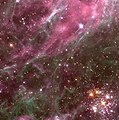 A WFPC2 image of a small region of the Tarantula Nebula in the Large Magellanic Cloud
 -
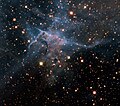 NASA Hubble Space Telescope near-infrared-light image of "Mystic Mountain" in the stellar nursery called the Carina Nebula.


Future[àtúnṣe | àtúnṣe àmìọ̀rọ̀]
Equipment failure[àtúnṣe | àtúnṣe àmìọ̀rọ̀]

Past servicing missions have exchanged old instruments for new ones, both avoiding failure and making possible new types of science. Without servicing missions, all of the instruments will eventually fail. In August 2004, the power system of the Space Telescope Imaging Spectrograph (STIS) failed, rendering the instrument inoperable. The electronics had originally been fully redundant, but the first set of electronics failed in May 2001.[134] This power supply was fixed during servicing mission 4 in May 2009. Similarly, the main camera (the ACS) primary electronics failed in June 2006, and the power supply for the backup electronics failed on January 27, 2007.[135] Only the instrument's Solar Blind Channel (SBC) was operable using the side-1 electronics. A new power supply for the wide angle channel was added during SM 4, but quick tests revealed this did not help the high resolution channel.[136]
HST uses gyroscopes to stabilize itself in orbit and point accurately and steadily at astronomical targets. Normally, three gyroscopes are required for operation; observations are still possible with two, but the area of sky that can be viewed would be somewhat restricted, and observations requiring very accurate pointing are more difficult.[137] There are further contingency plans for observations with just one gyro,[138] but if all gyros fail, continued scientific observations will not be possible. In 2005, it was decided to switch to two-gyroscope mode for regular telescope operations as a means of extending the lifetime of the mission. The switch to this mode was made in August 2005, leaving Hubble with two gyroscopes in use, two on backup, and two inoperable.[139] One more gyro failed in 2007.[140] By the time of the final repair mission, during which all six gyros were replaced (with two new pairs and one refurbished pair), only three gyros were still working. Engineers are confident that they have identified the root causes of the gyro failures,[141] and the new models should be much more reliable.[142]
Orbital decay[àtúnṣe | àtúnṣe àmìọ̀rọ̀]

Hubble orbits the Earth in the extremely tenuous upper atmosphere, and over time its orbit decays due to drag. If it is not re-boosted by a shuttle or other means, it will re-enter the Earth's atmosphere sometime between 2019 and 2032, with the exact date depending on how active the Sun is and its impact on the upper atmosphere. If Hubble were to descend in a completely uncontrolled re-entry, parts of the main mirror and its support structure would probably survive, leaving the potential for damage or even human fatalities.[143]
NASA's original plan for safely de-orbiting Hubble was to retrieve it using a space shuttle. The Hubble telescope would then have most likely been displayed in the Smithsonian Institution. This is no longer possible since the space shuttle fleet has been retired, and would have been unlikely in any case due to the cost of the mission and risk to the crew. Instead NASA considered adding an external propulsion module to allow controlled re-entry.[144] Ultimately NASA installed the Soft Capture and Rendezvous System, to enable retrieval by either a crewed or robotic mission.[84]
Successors[àtúnṣe | àtúnṣe àmìọ̀rọ̀]
| Visible spectrum range | |
| Color | Wavelength |
|---|---|
| violet | 380–450 nm |
| blue | 450–475 nm |
| cyan | 476–495 nm |
| green | 495–570 nm |
| yellow | 570–590 nm |
| orange | 590–620 nm |
| red | 620–750 nm |
There is no direct successor to the Hubble as an ultraviolet and visible-light space telescope, as near-term space telescopes do not duplicate Hubble's wavelength coverage (near-ultraviolet to near-infrared wavelengths), instead concentrating on the farther infrared bands. These bands are preferred for studying high redshift and low-temperature objects, objects generally older and farther away in the universe. These wavelengths are also difficult or impossible to study from the ground, justifying the expense of a space-based telescope. Large ground-based telescopes can image some of the same wavelengths as Hubble, sometimes challenge HST in terms of resolution (via adaptive optics), have much larger light-gathering power, and can be upgraded more easily, but cannot yet match the Hubble's excellent resolution over a wide field of view with the very dark background of space.
Plans for a Hubble successor materialized as the Next Generation Space Telescope project, which culminated in plans for the James Webb Space Telescope (JWST), the formal successor of Hubble.[145] Very different from a scaled-up Hubble, it is designed to operate colder and farther away from the Earth at the L2 Lagrangian point, where thermal and optical interference from the Earth and Moon are lessened. It is not engineered to be fully serviceable (such as replaceable instruments), but the design includes a docking ring to enable visits from other spacecraft.[146] A main scientific goal of JWST is to observe the most distant objects in the universe, beyond the reach of existing instruments. It is expected to detect stars in the early Universe approximately 280 million years older than stars HST now detects.[147] The telescope is an international collaboration between NASA, the European Space Agency, and the Canadian Space Agency since 1996,[148] and is planned for launch on an Ariane 5 rocket.[149] Although JWST is primarily an infrared instrument, its coverage extends down to 600 nm wavelength light, or roughly orange in the visible spectrum. A typical human eye can see to about 750 nm wavelength light, so there is some overlap with the longest visible wavelength bands, including orange and red light.

A complementary telescope, looking at even longer wavelengths than Hubble or JWST, is the European Space Agency's Herschel Space Observatory, launched on May 14, 2009. Like JWST, Herschel is not designed to be serviced after launch, and has a mirror substantially larger than Hubble's, but observes only in the far infrared.
Further concepts for advanced 21st-century space telescopes include the Advanced Technology Large-Aperture Space Telescope.[150], a conceptualized 8- to 16-meter (320- to 640-inch) optical space telescope that if realized could be a more direct successor to HST, with the ability to observe and photograph astronomical objects in the visible, ultraviolet, and infrared wavelengths, with substantially better resolution than Hubble or the Spitzer Space telescope. This effort is being planned for the 2025–2035 time frame.
| Selected space telescopes & instruments[151] | |||||||
| Name | Year | Wavelength | Aperture | ||||
|---|---|---|---|---|---|---|---|
| Human eye | — | 0.39–0.75 μm | 0.01 m | ||||
| Spitzer | 2003 | 3–180 μm | 0.85 m | ||||
| Hubble STIS | 1997 | 0.115–1.03 μm | 2.4 m | ||||
| Hubble WFC3 | 2009 | 0.2–1.7 μm | 2.4 m | ||||
| Herschel | 2009 | 60–672 μm | 3.5 m | ||||
| JWST | Planned | 0.6–28.5 μm | 6.5 m | ||||
Existing ground-based telescopes, and various proposed Extremely Large Telescopes, can exceed the HST in terms of sheer light-gathering power and diffraction limit due to larger mirrors, but other factors affect telescopes. In some cases, they may be able to match or beat Hubble in resolution by using adaptive optics (AO). However, AO on large ground-based reflectors will not make Hubble and other space telescopes obsolete. Most AO systems sharpen the view over a very narrow field—Lucky Cam, for example, produces crisp images just 10" to 20" wide, whereas Hubble's cameras are super sharp across a 2½' (150") field. Furthermore, space telescopes can study the heavens across the entire electromagnetic spectrum, most of which is blocked by Earth's atmosphere. Finally, the background sky is darker in space than on the ground, because air absorbs solar energy during the day and then releases it at night, producing a faint—but nevertheless discernible—airglow that washes out low-contrast astronomical objects.[152]
Ìtọ́kasí[àtúnṣe | àtúnṣe àmìọ̀rọ̀]
- "Hubble Space Telescope Primer for Cycle 17" (PDF). Space Telescope Science Institute (STScI). December 2011.[Ìjápọ̀ tí kò ṣiṣẹ́ mọ́]
- Allen, Lew (1990). "The Hubble Space Telescope Optical Systems Failure Report" (PDF). NASA Technical Report NASA-TM-103443. The definitive report on the error in the Hubble mirror.
- Dunar, A. J.; S. P. Waring (1999). Power To Explore—History of Marshall Space Flight Center 1960–1990. U.S. Government Printing Office. ISBN 0-16-058992-4. Chapter 12, The Hubble Space TelescopePDF (260 KB). Covers the development of the telescope.
- Logsdon, John M.; Amy Paige Snyder, Roger D. Launius, Stephen J. Garber, and Regan Anne Newport (PDF). NASA SP-2001-4407: Exploring the Unknown — Selected Documents in the History of the U.S. Civil Space Program. Volume V: Exploring the Cosmos. NASA. Archived from the original on 2017-01-20. https://web.archive.org/web/20170120024958/https://history.nasa.gov/SP-4407/vol5/ExploreUnknown.pdf. Retrieved 2012-05-26.. Contains many of the primary documents such as Spitzer's 1946 article, the Wood's Hole report on STScI autonomy, and the ESA memorandum of understanding. Also includes other NASA astronomy programs.
- Spitzer, Lyman S (1979). "History of the Space Telescope". Quarterly Journal of the Royal Astronomical Society 20: 29–36. Bibcode 1979QJRAS..20...29S. PDF version here [153]PDF. Covers the early history of precursors and proposals.
- Tatarewicz, Joseph N. "Chapter 16: The Hubble Space Telescope Servicing Mission". NASA. From the book SP-4219: From Engineering Science To Big Science. A detailed account of the first servicing mission.
- Zimmerman, Robert F. The Universe in a Mirror — The Saga of the Hubble Space Telescope and the Visionaries Who Built It, publ. Princeton UP (2008, 2010)
Ìkíyèsí[àtúnṣe | àtúnṣe àmìọ̀rọ̀]
- ↑ Lynn Jenner, Brian Dunbar. "The Hubble Story (page 2)". NASA. Archived from the original on 2011-08-20. Retrieved 2010-06-02.
- ↑ "STS-31". NASA. Retrieved March 7, 2012.
- ↑ HST Program Office (2003) (PDF). Hubble Facts: HST Orbit Decay and Shuttle Re-boost. Goddard Space Flight Center. http://hubble.nasa.gov/a_pdf/news/facts/sm3b/fact_sheet_reboost.pdf. Retrieved 2009-05-12.
- ↑ Amiko Kauderer (26 March 2009). "Space Shuttle Mission Overview — STS-125: The Final Visit". NASA. Archived from the original on 2015-08-10. Retrieved 2009-05-02.
- ↑ SYNPHOT User's Guide, version 5.0, Space Telescope Science Institute, p. 27
- ↑ "NASA's Great Observatories". NASA. Archived from the original on 2015-06-20. Retrieved 2008-04-26.
- ↑ H. Oberth (1923). Die Rakete zu den Planetenräumen. R. Oldenbourg-Verlay.
- ↑ Spitzer, L., "Report to Project Rand: Astronomical Advantages of an Extra-Terrestrial Observatory", reprinted in NASA SP-2001-4407: Exploring the Unknown Archived 2017-01-20 at the Wayback Machine., Chapter 3, Document III-1, p. 546.
- ↑ "Lyman Spitzer, Jr.". Caltech. Archived from the original on 2008-03-27. Retrieved 2008-04-26.
- ↑ Baum, W. A. àti Johnson, F. S. àti Oberly, J. J. àti Rockwood, C. C. àti Strain, C. V. àti Tousey, R. (November 1946). "Solar Ultraviolet Spectrum to 88 Kilometers". Phys. Rev (American Physical Society) 70 (9–10): 781–782. Bibcode 1946PhRv...70..781B. doi:10.1103/PhysRev.70.781.
- ↑ "The First Orbiting Solar Observatory". heasarc.gsfc.nasa.gov. NASA Goddard Space Flight Center. 26 June 2003. Retrieved 25 September 2011.
- ↑ "OAO". NASA. Archived from the original on 2013-02-18. Retrieved 2008-04-26.
- ↑ Spitzer, History of the Space Telescope, p. 32.
- ↑ Spitzer, History of the Space Telescope, pp. 33–34.
- ↑ 15.0 15.1 Spitzer, History of the Space Telescope, p. 34.
- ↑ "Memorandum of Understanding Between The European Space Agency and The United States National Aeronautics and Space Administration", reprinted in NASA SP-2001-4407: Exploring the Unknown Archived 2017-01-20 at the Wayback Machine., Chapter 3, Document III-29, p. 671.
- ↑ "A Chronology of the Hubble Space Telescope". NASA. Retrieved 2008-04-26.
- ↑ "The path to the Hubble Space Telescope". NASA. Archived from the original on 2008-05-08. Retrieved 2008-04-26.
- ↑ Dunar, pp. 487–488.
- ↑ 20.0 20.1 Dunar, p. 489.
- ↑ 21.0 21.1 "Hubble: The Case of the Single-Point Failure" (PDF). Science Magazine. 1990-08-17. Retrieved 2008-04-26.
- ↑ 22.0 22.1 Robberto, M. and Sivaramakrishnan, A. and Bacinski, J.J. and Calzetti, D. and Krist, J.E. and MacKenty, J.W. and Piquero, J. and Stiavelli, M. (2000). "The Performance of HST as an Infrared Telescope" (PDF). Proc. SPIE 4013: 386–393. doi:10.1117/12.394037. http://www.stsci.edu/hst/wfc3/documents/published/spie4013386.pdf.
- ↑ Allen report, p. 3–4.
- ↑ "Losing Bid Offered 2 Tests on Hubble". The New York Times. Associated Press. July 28, 1990. http://query.nytimes.com/gst/fullpage.html?res=9C0CEEDF1731F93BA15754C0A966958260. Retrieved April 26, 2008.
- ↑ "Hubble Space Telescope Stand-in Gets Starring Role". NASA. 2001-09-21. Archived from the original on 2008-02-26. Retrieved 2008-04-26.
- ↑ "Backup Mirror, Hubble Space Telescope". NASM. Archived from the original on 2012-11-02. Retrieved 2012-05-26.
- ↑ "2.4m Observatory Technical Note". New Mexico Institute of Mining and Technology. January 1, 2008. Archived from the original on November 29, 2011. Retrieved April 26, 2008.
- ↑ Dunar, p. 496
- ↑ Ghitelman, David, The Space Telescope, Michael Friedman Publishing, New York, 1987, p.32
- ↑ Dunar, p. 504.
- ↑ "Hubble Space Telescope Systems". Goddard Space Flight Center. Archived from the original on 2003-03-17. Retrieved 2008-04-26.
- ↑ Ghitelman, David, The Space Telescope, Michael Friedman Publishing, New York, 1987, p. 50
- ↑ Dunar, p. 508.
- ↑ "WFPC2". HubbleSite. Retrieved 2012-05-18.
- ↑ 35.0 35.1 Àdàkọ:Cite techreport 40 MB PDF file.
- ↑ Brandt J.C. et al. (1994). "The Goddard High Resolution Spectrograph: Instrument, goals, and science results". Publications of the Astronomical Society of the Pacific 106: 890–908. Bibcode 1994PASP..106..890B. doi:10.1086/133457.
- ↑ Bless R.C., Walter L.E., White R.L. (1992), High Speed Photometer Instrument Handbook, v 3.0, STSci
- ↑ Benedict, G. Fritz; McArthur, Barbara E. (2005). "High-precision stellar parallaxes from Hubble Space Telescope fine guidance sensors". In D.W. Kurtz (ed.). Proceedings of IAU Colloquium #196,. Transits of Venus: New Views of the Solar System and Galaxy. Cambridge University Press. pp. 333–346.
- ↑ Space Telescope Science Institute - AURA
- ↑ Dunar, pp. 486–487.
- ↑ Nancy Grace Roman, "Exploring the Universe: Space-Based Astronomy and Astrophysics", in NASA SP-2001-4407: Exploring the Unknown Archived 2017-01-20 at the Wayback Machine. Chapter 3, p. 536.
- ↑ Primer, Chapter 2.
- ↑ Diane Karakla, Editor and Susan Rose, Technical Editor (2004). HST Primer for Cycle 14.
- ↑ "Hubble Space Telescope Servicing Mission 4 Space Telescope Operations Control Center" (PDF). NASA. Archived from the original (PDF) on 2011-11-29. Retrieved 2012-05-26.
- ↑ Tatarewicz, SP-4219, p. 371.
- ↑ John Wilford (April 9, 1990). "Telescope Is Set to Peer at Space and Time". New York Times. http://query.nytimes.com/gst/fullpage.html?res=9C0CE3D6153AF93AA35757C0A966958260&sec=&spon=&pagewanted=all. Retrieved 2009-01-19.
- ↑ "STS-31". NASA. Archived from the original on 2011-08-15. Retrieved 2008-04-26.
- ↑ "The European Homepage for the NASA/ESA Hubble Space Telescope — Frequently Asked Questions". Retrieved 2007-01-10.
- ↑ Burrows C.J.; Holtzman, JA; Faber, SM; Bely, PY; Hasan, H; Lynda, CR; Schroeder, D (1991). "The imaging performance of the Hubble Space Telescope". Astrophysical Journal Letters 369: L21. Bibcode 1991ApJ...369L..21B. doi:10.1086/185950. http://ucp.uchicago.edu/cgi-bin/resolve?doi=10.1086/185950.[Ìjápọ̀ tí kò ṣiṣẹ́ mọ́]
- ↑ Heyer, Biretta; et al. (2004). "WFPC2 Instrument Handbook". 9.0. Baltimore: STScI. Chapter 5.1. Retrieved April 26, 2008.
- ↑ 51.0 51.1 "Servicing Mission 1". NASA. Archived from the original on April 20, 2008. Retrieved April 26, 2008.
- ↑ 52.0 52.1 Tatarewicz, p. 375.
- ↑ "The Naked Gun 2½: The Smell of Fear". Internet Movie Database. Retrieved April 26, 2008.
- ↑ Dunar, pp. 514–515.
- ↑ Allen, Chapter VII. The spacing of the field lens in the corrector was to have been done by laser measurements off the end of an invar bar. Instead of illuminating the end of the bar, however, the laser in fact was reflected from a worn spot on a black-anodized metal cap placed over the end of the bar to isolate its center (visible through a hole in the cap). The technician who performed the test noted an unexpected gap between the field lens and its supporting structure in the corrector and filled it in with an ordinary metal washer.
- ↑ Dunar, p. 512.
- ↑ Allen, p. 10-1.
- ↑ Chaisson, Eric (1994). The Hubble Wars; Astrophysics Meets Astropolitics in the Two-Billion-Dollar Struggle Over the Hubble Space Telescope. Harper Collins. ISBN 0-06-017114-6, p. 184.
- ↑ Fisher, Arthur (October 1990). "The Trouble with Hubble". Popular Science: 100. http://books.google.com/books?id=lQEAAAAAMBAJ&lpg=PA72&ots=2RSVwr5jro&pg=PA72#v=onepage&f=false. Retrieved November 8, 2012.
- ↑ Àdàkọ:Cite techreport
- ↑ Redding, David C (July 1995). "Optical Prescription of the HST". NASA JPL. Àdàkọ:Hdl. Unknown parameter
|coauthors=ignored (|author=suggested) (help); - ↑ Allen, Appendix E.
- ↑ 63.0 63.1 Tatarewicz, p. 376.
- ↑ Jedrzejewski, RI; Hartig, G; Jakobsen, P; Ford, HC (1994). "In-orbit performance of the COSTAR-corrected Faint Object Camera". Astrophysical Journal Letters 435: L7–L10. Bibcode 1994ApJ...435L...7J. doi:10.1086/187581.
- ↑ 65.0 65.1 "HST". STScI. Corrective Optics Space Telescope Axial Replacement. Retrieved November 4, 2012.
- ↑ Tatarewicz, pp. 384–387.
- ↑ Trauger, J.T. et al. (1994). "The on-orbit performance of WFPC2". Astrophysical Journal Letters 435: L3–L6. Bibcode 1994ApJ...435L...3T. doi:10.1086/187580.
- ↑ "Servicing Mission 2". NASA. Archived from the original on April 19, 2008. Retrieved April 26, 2008.
- ↑ 69.0 69.1 "NICMOS Thermal History". STScI. Retrieved April 26, 2008.
- ↑ "Servicing Mission 3A Overview". NASA. Archived from the original on May 9, 2008. Retrieved April 26, 2008.
- ↑ Àdàkọ:Cite techreport
- ↑ "Servicing Mission 3". NASA. Archived from the original on April 7, 2008. Retrieved April 26, 2008.
- ↑ "Servicing Mission 4 Cancelled". STScI. January 16, 2004. Retrieved April 28, 2008.
- ↑ "2004 Annual Report" (PDF). Astronomy and Astrophysics Advisory Committee. March 15, 2004. Section 3.1 – The Scientific Impact of the HST SM4 Cancellation. Retrieved November 5, 2012.
- ↑ Warren E. Leary (July 14, 2004). "Panel Urges NASA to Save Hubble Space Telescope". New York Times. Retrieved November 8, 2012.
- ↑ Gugliotta, Guy (April 12, 2005). "Nominee Backs a Review Of NASA's Hubble Decision". The Washington Post. http://www.washingtonpost.com/wp-dyn/content/article/2005/04/12/AR2005041201646.html. Retrieved January 10, 2007.
- ↑ "Mikulski Vows To Fight For Hubble" (Press release). Barbara Mikulski. February 7, 2005. Archived from the original on April 30, 2008. Retrieved April 26, 2008.
- ↑ Boyle, Alan (October 31, 2006). "NASA gives green light to Hubble rescue". MSNBC. http://www.msnbc.msn.com/id/15489217/. Retrieved January 10, 2007.
- ↑ 79.0 79.1 Cowen, Ron (September 29, 2008). "Hubble suddenly quiet". ScienceNews. Retrieved November 8, 2012.
- ↑ Courtland, Rachel (October 28, 2008). "Hubble re-opens an eye". New Scientist. Archived from the original on October 29, 2008. Retrieved October 29, 2008.
- ↑ 81.0 81.1 "Hubble Essentials". STScI. Retrieved November 8, 2012.
- ↑ "NASA Sets Target Shuttle Launch Date for Hubble Servicing Mission". NASA. December 4, 2008. Retrieved December 5, 2008.
- ↑ "Hubble Opens New Eyes on the Universe". NASA. September 9, 2009. Retrieved May 28, 2012.
- ↑ 84.0 84.1 "The Soft Capture and Rendezvous System". NASA. Archived from the original on September 11, 2008. Retrieved May 20, 2009.
- ↑ Bahcall, JN; Bergeron, J; Boksenberg, A; Hartig, GF; Jannuzi, BT; Kuuiakos, S; Sargent, WLW; Savage, BD et al. (1993). "The Hubble Space Telescope Quasar Absorption Line Key Project. I. First Observational Results, Including Lyman-Alpha and Lyman-Limit Systems". The Astrophysical Journal Supplement Series 87: 1–43. Bibcode 1993ApJS...87....1B. ISSN 0067-0049.
- ↑ Ostrander, EJ; Nichol, RC; Ratnatunga, KU; Griffiths, RE (1998). "The Hubble Space Telescope Medium Deep Survey Cluster Sample: Methodology and Data". The Astronomical Journal 116 (6): 2644. arXiv:astro-ph/9808304. Bibcode 1998AJ....116.2644O. doi:10.1086/300627. http://iopscience.iop.org/1538-3881/116/6/2644.
- ↑ Huchra, John. "The Hubble Constant". Retrieved January 11, 2011.
- ↑ Freedman, WL; Madore, BF; Gibson, BK; Ferrarese, L; Kelson, DD; Sakai, S; Mould, JR; Kennicutt, RC Jr et al (2001). "Final Results from the Hubble Space Telescope Key Project to Measure the Hubble Constant". The The Astrophysical Journal 553 (1): 47–72. arXiv:astro-ph/0012376. Bibcode 2001ApJ...553...47F. doi:10.1086/320638. Preprint available here.
- ↑ Clifton, Timothy; Ferreira, Pedro G (March 23, 2009). "Does Dark Energy Really Exist?". Scientific American. http://www.scientificamerican.com/article.cfm?id=does-dark-energy-exist. Retrieved June 16, 2009.
- ↑ Seife, Charles (June 20, 2003). "Dark Energy Tiptoes Toward the Spotlight". Science 300 (5627): 1896–1897. doi:10.1126/science.300.5627.1896. PMID 12817137.
- ↑ "Hubble Confirms Existence of Massive Black Hole at Heart of Active Galaxy". Goddard Space Flight Center. May 25, 1994. Retrieved April 26, 2008.
- ↑ Gebhardt, K; Bender, R; Bower, G; Dressler, A; Faber, SM; Filippenko, AV; Green, R; Grillmair, C; Ho, LC; Kormendy, J et al (2000). "A Relationship between Nuclear Black Hole Mass and Galaxy Velocity Dispersion". The Astrophysical Journal 539 (1): L13–L16. arXiv:astro-ph/0006289. Bibcode 2000ApJ...539L..13G. doi:10.1086/312840.
- ↑ Ferrarese, Laura; Merritt, David (2000). "A Fundamental Relationship between Supermassive Black Holes and their Host Galaxies". The Astrophysical Journal 539 (1): L9–L12. arXiv:astro-ph/0006053. Bibcode 2000ApJ...539L...9F. doi:10.1086/312838.
- ↑ "Hubble Confirms Abundance of Protoplanetary Disks around Newborn Stars". STScI. June 13, 1994. Retrieved April 26, 2008.
- ↑ "Hubble Finds Extrasolar Planets Far Across Galaxy". NASA. October 4, 2006. Retrieved April 26, 2008.
- ↑ "Autopsy of an Explosion". NASA. March 26, 1999. Archived from the original on June 30, 2011. Retrieved April 26, 2008.
- ↑ "APOD: March 11, 1996 – Hubble Telescope Maps Pluto". NASA. Retrieved 2008-04-26.
- ↑ "Astronomers Measure Mass of Largest Dwarf Planet" (Press release). STScI. June 14, 2007. Retrieved April 26, 2008.
- ↑ Brumfiel, Geoff (September 19,2008). "How they wonder what you are". Nature. http://www.nature.com/news/2008/080919/full/news.2008.1122.html. Retrieved November 4, 2012.
- ↑ Gänsicke, BT; Levan, AJ; Marsh, TR; Wheatley, PJ (2009). "SCP06F6: A carbon-rich extragalactic transient at redshift z~0.14?". The Astrophysical Journal 697 (1): L129–L132. arXiv:0809.2562. doi:10.1088/0004-637X/697/2/L129.
- ↑ "Hubble discovers fifth and tiniest Pluto moon". The Indian Express. July 12, 2012. http://www.indianexpress.com/news/hubble-discovers-fifth-and-tiniest-pluto-moon/973490/0.
- ↑ "HST Publication Statistics". STScI. Retrieved September 9, 2009.
- ↑ STScI Newsletter 20 (2). Spring 2003.
- ↑ Benn, CR; Sánchez, SF (2001). "Scientific Impact of Large Telescopes". Publications of the Astronomical Society of the Pacific 113 (781): 385. arXiv:astro-ph/0010304. Bibcode 2001PASP..113..385B. doi:10.1086/319325.. arXiv preprint.
- ↑ Haniff, CA; Mackay, CD; Titterington, DJ; Sivia, D; Baldwin, JE, (August 1987). "The first images from optical aperture synthesis". Nature 328 (6132): 694. Bibcode 1987Natur.328..694H. doi:10.1038/328694a0.
- ↑ Buscher, DF; Baldwin, JE; Warner, PJ; Haniff, CA (July 1990). "Detection of a bright feature on the surface of Betelgeuse". Monthly Notices Royal Astronomical Society 245: 7. Bibcode 1990MNRAS.245P...7B.
- ↑ "HST Call for Proposals", Chapter 2.3 Archived 2012-12-15 at Archive.is.
- ↑ "HST Overview". NASA. June 21, 2010. Mission Operations and Observations. Retrieved November 4, 2012.
- ↑ "Team Hubble". STScI. Retrieved November 5, 2012.
Each year more than 1,000 proposals are reviewed and approximately 200 are selected.
- ↑ "HST Call for Proposals", http://www.stsci.edu/hst/proposing/documents/cp/3_Proposal_Categories4.html Archived 2012-01-26 at the Wayback Machine. Chapter 2.3.
- ↑ "HST Call for Proposals", Chapter 3.8 Archived 2008-05-16 at the Wayback Machine..
- ↑ "Amateur Astronomers Will Use NASA's Hubble Space Telescope". STScI. September 10, 1992. Retrieved April 26, 2008.
- ↑ Secosky J; Potter M (1994). "A Hubble Space Telescope Study of Posteclipse Brightening and Albedo Changes on Io". Icarus 111: 73–78. Bibcode 1994Icar..111...73S. doi:10.1006/icar.1994.1134.
- ↑ O'Meara, Stephen J (June 1997). "The Demise of the HST Amateur Program". Sky and Telescope 96 (6): 97. Àdàkọ:Bibcode.
- ↑ STScI (April 22, 2010). "Starry-Eyed Hubble Celebrates 20 Years of Awe and Discovery" (Press release). Retrieved November 4, 2012.
- ↑ 116.0 116.1 "Team Hubble". STScI. Data Management. Retrieved November 5, 2012.
- ↑ "JPL Horizons Object Data Page, Hubble Space Telescope". JPL.
- ↑ "The Hubble Telescope". STScI. Retrieved 2008-04-26.
- ↑ "CADC's Hubble Space Telescope Archive". CADC. Retrieved 2008-04-26.
- ↑ "Hubble Space Telescope Data - Science Archive Facility". ESO. Retrieved 2010-10-27.
- ↑ "HST Call for Proposals", Chapter 5.1 Archived 2018-04-01 at the Wayback Machine..
- ↑ "HST Primer for Cycle 20", Chapter 7.2 Archived 2018-05-08 at the Wayback Machine..
- ↑ "The Hubble Heritage Project". STScI. Retrieved November 05, 2012. Check date values in:
|access-date=(help) - ↑ "HST Primer", Chapter 7.1 Archived 2018-05-08 at the Wayback Machine..
- ↑ "HST Primer", Chapter 7.1.1 Archived 2018-05-08 at the Wayback Machine..
- ↑ "National Aeronautics and Space Administration 2003 Strategic Plan" (PDF). NASA. Archived from the original (PDF) on October 18, 2012. Retrieved November 5, 2012.
- ↑ "The Hubble Heritage Project". STScI. Retrieved November 5, 2012.
- ↑ "HubbleSite". STScI. Retrieved 2008-04-26.
- ↑ "NewsCenter". STScI. Retrieved 2008-04-26.
- ↑ "News Release Archive: Entire Collection". STScI. Retrieved 2008-04-26.
- ↑ "Hubble Public Talks". STScI. Retrieved 2008-04-26.
- ↑ "The European Homepage For The NASA/ESA Hubble Space Telescope". ESA. Retrieved 2008-04-26.
- ↑ "Historic Hubble Space Telescope Repair Mission Team Honored by the Space Foundation with 2010 Space Achievement Award" (Press release). 26th National Space Symposium. March 29, 2010. Archived from the original on March 6, 2012. Retrieved November 5, 2012.
- ↑ "Space Telescope Imaging Spectrograph". STScI. Retrieved April 26, 2008.
- ↑ "Engineers Investigate Issue on One of Hubble's Science Instruments". NASA. January 29,2007. Retrieved April 26, 2008. Check date values in:
|date=(help) - ↑ "Advanced Camera for Surveys". STScI. Retrieved May 21, 2009.
- ↑ Sembach, KR, et al. (2004). HST Two-Gyro Handbook. Version 1.0. Baltimore: STScI.
- ↑ "NASA Hubble Space Telescope Daily Report # 4537". SpaceRef. January 31, 2008. Retrieved January 6, 2009.[Ìjápọ̀ tí kò ṣiṣẹ́ mọ́]
- ↑ "NASA/ESA Hubble Space Telescope Begins Two-Gyro Science Operations". SpaceRef. September 1, 2005. Retrieved January 9, 2009.[Ìjápọ̀ tí kò ṣiṣẹ́ mọ́]
- ↑ Hecht, Jeff (September 6, 2007). "Hubble telescope loses another gyroscope". NewScientist. Retrieved January 6, 2009.
- ↑ "Gyroscopes". ESA. Retrieved June 9, 2012.
- ↑ Harwood, William (October 30, 2008). "Endeavour to go Nov. 14; Hubble slips deeper into '09". Spaceflight Now. Retrieved January 6, 2009.
- ↑ Whitehouse, Dr. David (January 17, 2004). "Why Hubble is being dropped". BBC News. http://news.bbc.co.uk/2/hi/science/nature/3406079.stm. Retrieved January 10, 2007.
- ↑ Cowing, Keith (July 22, 2005). "NASA Considering Deletion of Hubble Deorbit Module". SpaceRef. Archived from the original on May 30, 2012. https://archive.ph/20120530063700/http://www.spaceref.com/news/viewnews.html?id=1050. Retrieved January 10, 2007.
- ↑ Matson, John (May 8, 2009). "Last Dance with the Shuttle: What's in Store for the Final Hubble Servicing Mission". Scientific American. Retrieved May 18, 2009.
- ↑ Berger, Brian (May 23, 2007). "NASA Adds Docking Capability For Next Space Observatory". Space.com. Retrieved June 4, 2012.
- ↑ "NASA's Hubble Finds Most Distant Galaxy Candidate Ever Seen in Universe" (Press release). NASA. January 26, 2011. Retrieved June 4, 2012. Visual representation.
- ↑ "ESA JWST Timeline". Sci.esa.int. June 30, 2003. Retrieved June 4, 2012.
- ↑ "About Webb's Launch". NASA. Retrieved November 4, 2006.
- ↑ "What Will Astronomy Be Like in 35 Years?". Astronomy. August 2008.
- ↑ "JPL: Herschel Space Observatory: Related Missions". Herschel.jpl.nasa.gov. Retrieved 2012-06-04.
- ↑ Fienberg, Rick (September 14, 2007). "Sharpening the 200-Inch". Sky and Telescope. Archived from the original on September 10, 2012. Retrieved July 1, 2008.
- ↑ Spitzer, Lyman. "1979QJRAS..20...29S Page 29". Quarterly Journal of the Royal Astronomical Society (Articles.adsabs.harvard.edu) 20: 29. Bibcode 1979QJRAS..20...29S.
Ìwé kíkà ní ẹ̀kúnrẹ́rẹ́[àtúnṣe | àtúnṣe àmìọ̀rọ̀]
- "The transition from Hubble to JWST" (PDF). HST-JWST Transition Panel. August 2003.
- Pearce, Rohan. "What went wrong with the Hubble Space Telescope (and what managers can learn from it)". Techworld. http://www.techworld.com.au/article/420036/what_went_wrong_hubble_space_telescope_what_managers_can_learn_from_it_/?. Retrieved March 30, 2012.
- Zimmerman, Robert F. (2010). The Universe in a Mirror: The Saga of the Hubble Space Telescope and the Visionaries Who Built It. Princeton University Press. ISBN 978-0691146355.
Àwọn àjápọ̀ òde[àtúnṣe | àtúnṣe àmìọ̀rọ̀]
 |
Wikimedia Commons ní àwọn amóunmáwòrán bíbátan mọ́: Tẹ́lískópù Òfurufú Hubble |
- HubbleSite, Hubble website for the public (operated by the Space Telescope Science Institute)
- Hubble Heritage Project, including a gallery of famous HST pictures.
- NASA Hubble pages
- Where's Hubble now..., an interactive map of Hubble's current location and orbital track
- Spacetelescope, ESA's public Hubble pages
- "A Brief History of the Hubble Space Telescope" from the NASA History Office
- Hubble data archive
- The transition from Hubble to JWSTPDF (182 KB) (August 2003 report)
- Hubblecast video from Dailymotion
- Amateur observations with Hubble, and a related press report
- Hubble's current position, via Google Maps
- Hubble at 20 Archived 2011-08-25 at the Wayback Machine. - slideshow by The First Post
- Hubble's first 20 years with Professor Alec Boksenberg from the Institute of Astronomy in Cambridge
- Pearce, Rohan (March 29, 2012). "What went wrong with the Hubble Space Telescope (and what managers can learn from it)". Computerworld Techworld. http://www.techworld.com.au/article/420036/what_went_wrong_hubble_space_telescope_what_managers_can_learn_from_it_/?. Retrieved March 30, 2012.
| Policy and history |
|  | |||||
|---|---|---|---|---|---|---|---|
| Robotic programs |
| ||||||
| Human spaceflight programs |
| ||||||
| Individual featured missions (human and robotic) |
| ||||||
| Space Comm and Nav (SCaN) | |||||||
| NASA categories and lists | |||||||
| Current | |
|---|---|
| Planned |
|
| Proposals | |
| Completed |
|
| Lost |
|
| Completed | |
| On hiatus | |
| Old plans | |
| See also | |


- Pages using Timeline
- Pages using duplicate arguments in template calls
- Webarchive template wayback links
- CS1 maint: Multiple names: authors list
- CS1 maint: Extra text: editors list
- All articles with dead external links
- Articles with dead external links from September 2023
- Articles with invalid date parameter in template
- Articles with permanently dead external links
- CS1 maint: Explicit use of et al.
- Pages with citations using unsupported parameters
- Pages using web citations with no URL
- CS1 maint: display-authors
- Webarchive template archiveis links
- CS1 errors: dates
- Pages using ISBN magic links
- Articles containing German-language text
- Pages containing cite templates with deprecated parameters
- Àwọn tẹ́lískópù òfurufú
- Àwọn agbéwọ̀ọ́kán òfurufú
- Tẹ́lískópù Òfurufú Hubble